Gwyn Morgan, in case you missed it, is a far right-wing conservative oil man. He loves Ralph Klein and is a Trustee of the Fraser Institute and a Director of the Manning Center for Building Democracy.
The record of Ralph Klein speaks for itself.
The Fraser Institute's Mission Statement states, "Our vision is a free and prosperous world where individuals benefit from greater choice, competitive markets and personal responsibility." Among its board members is Peter Pocklington.
The Manning Center is headed by its CEO, Preston Manning, former leader of the Reform Party and son of Ernest, longtime Social Credit Premier of Alberta and convert to conservatism following the Leduc oil discovery. Part of the Mission of the Manning Center states that it "is commited to achieving a democratic society guided by conservative principles." Its literature also states that it "is commited to the support of issue campaigns that will increase public interest in and support for conservative-oriented ideas and policy proposals."
So Gwyn Morgan is a conservative.
He is so conservative that like many of his colleagues and fellow travelers, his memory often fails him. An example appeared in a Globe and Mail column on October 29, Populism tramples Principle in Alberta, in which he gave Premier Stelmach a good thrashing for increasing royalties to be paid by the oil and gas industry.
In referring to Klein near the beginning of his piece, Morgan wrote that when Ralph became Premier, "Alberta was suffering the after effects of Trudeau's national energy program followed by a prolonged slump in energy prices." A mere half of that statement is correct - the part about the slump in energy prices. The rest is hogwash. Some might even say it was pure bullshit.
First of all, the National Energy Program was introduced in October, 1980. Secondly, Morgan's pal Brian Mulroney became Prime Minister in the fall of 1984. Thirdly, Mulroney and the signing of the Western Accord trashed the last remnants of the NEP at the end of March 1985. Fourthly, Morgan's pal and idol Klein did not become Premier until December 14, 1992 - a full 12 years after the National Energy Program and more than 7 years after its demise.
And fifthly - in every other jurisdiction of this whole wide world, credible business leaders remember the havoc brought down on world economies by high interest rate policies led by the Federal Reserve Board of the United States in the early 1980's. Morgan and his fellow conservative travelers never remember this when discussing the difficult times during the eighties. They remember only the NEP. But here are the facts:
- - in October 1980 - the same month of the introduction of the NEP, the prime rate of the Federal Reserve Board of the United States rose from 13.5% to 14.5%
- - in November 1980, the prime rate of the Federal Reserve Board rose from 15.50% to 17.75%.
- - in December by Christmas of 1980 the rate was 20.50%
- - in September 1981, the rate was 20%, after which it began a slow and tortuous slide downwards.
The results of those punitive interest rates was a prolonged spate of foreclosures across North America which lasted for years, the like of which had not been witnessed since the Great Depression.
So, what are we to make of the oft-feted Morgan? Is he Pinocchio? Does he have failing memory because of age (he is only in his early sixties and works out religiously, apparently)? Or is he a conservative political hack?
It's your pick.
Monday, October 29, 2007

Thursday, October 25, 2007
GRAY'S ANATOMY: ALMOST PERFECT BUT FOR BLINDSPOTS
I have known Jim Gray for forty years. A hell of a lot of Calgarians have known him for a long time. And they like him. For good reason. He's accomplished a lot, and he's contributed a lot.
In business he was a co-founder of Canadian Hunter Exploration and helped it to become one of the most successful companies in the oil patch. In 2000 he chaired the 16th World Petroleum Congress held in Calgary. He has been a driving force behind the success of the Science Alberta Foundation, the Achievement Centre for Youth, the Calgary Women's Emergency Shelter, the Calgary Native Friendship Center, and many undertakings of the YMCA, among many other worthwhile organizations and projects. He has served on the Boards of Directors of many important Canadian companies including, the Canadian National Railway, Brascan, and the Hudson's Bay Company.
For all of this and more, he has been justly recognized, receiving an Honourary Doctor of Laws from the University of Calgary, a Citation for Citizenship from the Government of Canada, an appointment as an Officer of the Order of Canada, and an appointment to the Alberta Order of Excellence.
Jim Gray is not your average Albertan. No siree. But he isn't perfect either. He's got some problems with his vision. They are called 'blind spots.'
Jim wrote a column that appeared in the Calgary Herald on Tuesday, October the 23rd, entitled 'Averages are for Losers.' Alas, the purpose was to add his voice as a shill for the industry that has been so good to him, in its efforts to scare the bejesus out of average Albertans so that
Premier Stelmach would reject the proposals of the Royalty Review panel.
The panel had been vociferous in arguing that there should be an increase in royalties paid by oil and gas producers by a couple of billion bucks - so that average Albertans who own the resources 'get their fair share.' The panel's conclusions were supported by Alberta's Auditor General and the Department of Energy number crunchers as well.
In searching for some resonance with his readers, Gray chose flattery. "Albertans," he writes, "are not average. This province was not built by people of average commitment and determination." He speaks of 'visionary Albertans' as having built "a wonderful province with a quantity and a quality of life that is the envy of others in the world."
He urged the Stelmach to be cautious in considering the royalty review, because it might scare these non-average visionary builders of the province into leaving for some place else together with their non-average abilities and money. Like some banana republic, in some hell-hole rich in the black gooey stuff, I suppose, because that seems to be the only kind of place where you can find oil in such abundance as we have here.
Of course, this was bunk. Most Albertans are average. They are the Marthas and Henrys that Gray's hero Ralph Klein used to talk about. They are not particularly visionary and neither do they have above average commitment and determination in the pursuit of the almighty buck.
What the average Albertan wants, works for, and needs - and what they are not getting - is 'a fair share' of the spoils of Klein's 'Alberta Advantage.'
Gray has received his 'fair share' long ago. He doesn't have to worry about his kids going to a nearby elementary school that doesn't exist. He doesn't have to worry about not getting timely and excellent health care - a man of his means can go to the best of America's elite health care institutions and be well cared for by writing a simple large cheque. Neither is it much of a problem for him if there are no places for his grandkids at local Universities - they can seamlessly travel to some other city that has more classrooms. Roads are not a problem for him, nor are bridges. His driving days were over long ago, when he received his first fat pension cheque.
And if Jim Gray is so respectful of 'vision,' 'commitment, 'determination,' and 'above average' performance, why on earth did he slavishly support for so long, the dumb and dumber government of Ralph Klein? Gray is a noted long-time Progressive Conservative party worker and bagman, whose most productive years came on behalf of the guy who had neither a plan nor ideas.
You remember the Klein government, I'm sure. Its the one that was so devoted to getting rid of the deficit and then the debt, that it fell hopelessly behind in the maintenance and building of roads, bridges, hospitals, schools and universities. The same government, you will recall, that dawdled and dithered while construction costs spiraled out of sight. Yes, its the same government that, through its heavy handed attempts to shove private medicine down the throats of Albertans, caused a scandalous deterioration of hospital services as well as a chronic shortage of doctors and nurses. You remember, it was the same government that had no plan and is leaving the mess to the prairie yahoos of Ed Stelmach to clean up. God help us.
Well, Jim Gray supported that below average government for a very long time indeed, and he was happy to do it.
Anyway, Gray and his cohorts succeeded. They worked their magic. Stelmach knuckled under. Flying in the face of the opinion of every energy expert worth his salt, Stelmach caved. Apart from making it far more difficult for small oil and gas producers, he left royalties by and large unchanged. So unchanged that energy stocks in the stock market actually went up!
And average Albertans are still not going to get 'their fair share.'
.
Monday, October 22, 2007
ITALIAN SENTIMENTAL JOURNEY: BACK TO BROSSO

Those of you who know me are aware of my intense pride in my Italian/Belgian heritage. My father was of Belgian parentage and my mother Italian.
In late August, together with my son Derek (he of ‘Born with a Tail’ blog fame), I returned to the homeland of my maternal grandparents for a short visit. The village is called Brosso and the general area is named the Canavese. It is located in the region of Piedmont in the northwest Province of Torino, in the foothills of the Italian Alps.
My mother’s maternal grandfather and uncle, whose family name was 'Bolettino,' left Brosso for Canada around the turn of the last century. Like countless other European immigrants to Canada, they came to make some money for their family, who stayed back in Italy waiting patiently for their return. If everything worked out they would have their family join them in their new homeland. Perhaps they could escape the class system, frequent wars and deprivation, and a cramped difficult life of hard toil and little opportunity.
It was not to be. The uncle, Stefano (Stephen or Steve in English) Bolettino was killed in a coal mining accident in Canmore in 1901. He is buried in the old Canmore cemetery. He was 17 at the time of his death. Stefano's father died in the southern Alberta town of Taber four years later of a heart attack, so the story goes. He too is buried in Canmore, next to Stefano. They never did return to Italy and neither did their families ever join them in Canada.
In 1909, my paternal grandfather Giovanni (John) Bovio together with his wife Irene – the daughter of the miner who died in Taber and the sister of young Stefano - immigrated to Canada. No doubt their reasons were the same - to seek opportunity and to get away from the vicissitudes of the European struggles of the times. They settled in Bellevue, a coalmining town in the Crowsnest Pass lying just on the eastern edge of the Frank Slide in southwestern Alberta.
Communications were never lost between the Canadian family and the family left in Italy. My grandparents - the Bovios - kept exchanging letters with their brothers, sisters and cousins from the time of their arrival in Canada. When they passed away, my mother and aunt continued to maintain contact. And in 1954 my first cousin, Gary Vernon, who later made his home in Ottawa , was the first of the family to return for a visit. Since that time, my mother and aunt, both now deceased, and my cousin Gary and I and our families have made many return visits to the ancestral homeland. We continue to exchange letters, cards and now emails with our Piemontese cousins.
What follows is a description of the recent visit of Derek and I to Brosso, together with some geographical and historical background of the region.

Road from Malpensa to Ivrea
ARRIVAL – TUESDAY AUGUST 21
I flew from Calgary to Malpensa airport west of Milan, via London arriving at dusk at about 7:30 PM in a blinding rainstorm. I picked up my car with little difficulty from Eurocar Rentals.
But then the problems began. I had tried to acquaint myself with all of the doodads of an Alpha Romeo (diesel, and a reasonably pedestrian model by Italian standards). After doing so I made a valiant effort at getting out of the airport in the face of the driving rainstorm. I could not read the signs. I could not tell if my lights were on or off. I would hit a veritable lake of water on the road and think that my car would stall., if not completely submerge. Try as I might, I could not even see the signs to the little village where my hotel – called the ‘First Hotel’ – was located. I drove on this nightmare for an hour, and finally found my way back to the car rental agency at the airport. I told them I would pick up the car the next day when I could see.
The next day I discovered that the 'First Hotel' was 1 km from Terminal 1 and Terminal 2. Lesson learned - after a long flight, just check into your hotel. Rise up to the challenges of travel the next morning.
Happily, the ‘First Hotel’ had a shuttle van from the Airport and so I made it there quickly and with no further problem. It was a small hotel in a little village. In order to get to the hotel the shuttle had to maneuver many turns on the narrow road inside the village. I don’t think I could have found it if I had been driving – after flying all the way from Calgary without a break.
Happily, the ‘First Hotel’ had a shuttle van from the Airport and so I made it there quickly and with no further problem. It was a small hotel in a little village. In order to get to the hotel the shuttle had to maneuver many turns on the narrow road inside the village. I don’t think I could have found it if I had been driving – after flying all the way from Calgary without a break.
First Hotel was a pleasant and clean place and very convenient for the traveler arriving late at night. I arrived at about 11 PM. Although the restaurant was closed, they whipped up a plate of excellent lasagna and after that together with a couple of glasses of excellent vino rosso, I retired for the evening and slept soundly. 
DAY ONE – WEDNESDAY AUGUST 22
DAY ONE – WEDNESDAY AUGUST 22
The next morning I took the shuttle back to the car rental agency and drove the Alpha Romeo out of the lot onto the highway. From the time of my first shift came the unmistakable sound of grinding gears. Italians like the standard shifts for some ungodly reason. I found the A4 autostrada out of Novara and proceeded westward gradually getting into the beautiful hills around Ivrea.
Entering the autostrada - a six-lane divided toll highway - was interesting. I had forgotten how to do it. I drove up to an unmanned gate and puzzled over what happened next. The gate was closed. There was no one to give me a ticket and looking at the bells and whistles of the machine outside of the window of the driver’s side literally rang no bells for me. After puzzling over this for several minutes, and with impatient Italian drivers in back of me leaning on their horns, I pushed the ‘help’ button. An exasperated voice came over the intercom. It sounded as though it was saying: “Poo teegat.”
Now what the hell could that mean - "Poo teegat?" After a few more desperate minutes it came to me. “You dummy!” I thought. ‘Pull ticket” is what the guy was telling me. As luck would have it, there was a ticket at the bottom of the machine to be pulled. I ‘pooed' the 'teegat,’ and voila! The gate opened and I was on the A4 from Milano to Torino.

"Poo Teegat"
I had arranged to meet Derek at 1 PM at the train station in Ivrea. I exited the A4 just east of Ivrea. I marveled at the impressive green, wooded, hilly and mountainous terrain, which had dimmed in my memory in the fourteen years since I had been there last.

Ivrea Countryside
I drove through the village of Banquette, turned left where the sign said ‘Centro’ and went along the Via Torino until I saw the unmistakable front of the Station, which I had seen many times over five previous visits. I drove into the parking area and was about to turn off the engine when Derek opened the passenger door and remarked on the accuracy of our timing. It was exactly 1 PM.
Ivrea is a city of some 25 or 30 thousand lying about 50 kilometers north of the City of Torino (known to anglos as ‘Turin,’ and the home of the ’88 Winter Olympic Games). It is part of a greater Torino metropolitan area which contains – including the city of Torino – about two and half million people living in many surrounding towns and villages. This is part of the industrial heartland of Italy – a highly prosperous northern strip extending west to east from Genoa to Torino, through Milan, and to Venice on the Adriatic.
Ivrea was the birthplace and home for many years of the famous Olivetti Business Machine corporation. It lies nestled in the foothills of the Italian Alps and marks the southern beginning of the magnificent Val D’Aosta. The Val d'Aosta then extends northwards into the Alps of France, Switzerland and Italy. These mountains, which are home to some of the great ski areas of the continent, are little more than an hour or so away.
We drove to the hotel – ‘La Villa’ - two kilometers south of the station along Via Torino. ‘La Villa’ is a comfortable and clean, family run hotel, with a nourishing breakfast room and pleasant management. We then rested and talked for an hour before I called my cousin Betty. Twenty minutes later she arrived at the hotel. Betty grew up and was educated in London, where her mother and father (a first cousin of my mother) had immigrated after the Second World War. She and her mother, Fiora, had returned to live in Italy in the mid sixties after the death of her father. Betty had a fine career as an executive secretary with the Olivetti organization. She is an invaluable companion as a friend and translator whenever I or any of my family visit.
French is spoken and widely understood in the region because of the geographical and historical proximity to France and French speaking Switzerland. And like other locales in western Europe, there are increasing numbers who speak English, particularly among the young, who have been taught English in school. Although my Italian is less than adequate, my French is much better, and between the three languages, I communicate reasonably well with everyone.
She then took us on a short tour of Ivrea and its immediate surroundings. We stopped first of all to see the lake at Lake Sirio, located in a small valley east of Ivrea. It is one of the many picturesque smaller lakes in the region, and is surrounded by forests, which are scattered with well-built and well-cared for villas.

Lake Sirio

Betty’s cousin and her husband have a small resort at Lake Sirio. It includes a swimming area, cabanas, a concession stand and a restaurant. The cousin is a tall, fair-haired, svelte, attractive woman of 40 or so who is married to a highschool physical education teacher. His family have been operating this very pleasant facility for many years.
After taking some time to admire the view and the resort, we went to the nearby Hotel Sirio to have a look around. The hotel was nicely appointed in an attractive minimalist Scandinavian style. But make no mistake - a classy operation - very upscale and comfortable I am sure.
After a few minutes at the Hotel Sirio, we got into Betty’s car and proceeded a few kilometres to the top of a steep incline, where we arrived at the Castello di St. Giuseppe, a beautiful old castle that was converted into a first class hotel some years ago. It has a commanding view of Ivrea and its lake-studded wooded environment.
Ivrea, I must say is looking good. And prosperous. Although it was said that there was some hardship when Olivetti closed its operations there a few years ago, you could not tell it by the construction that is going on. There are many new homes, condos, and commercial establishments being built in various stages of completion. There is also plenty of renovation and restoration going on in the old town of Ivrea. The two large piazzas are now traffic free and the buildings surrounding the squares have been rehabilitated to their former grandeur.

Ivrea - Piazza Vittorio Emanuele
We arrived at Betty and Fiora’s comfortable condo in Ivrea at about 6 PM. Betty prepared an excellent spaghetti and caprese salad dinner and we continued our discussions. Fiora is a marvel. Looking at least 25 years younger than her 97 years, she has great wit, and a prodigious memory. Her sister, who lives in London, is still going strong at 100. She is also spry and gives every impression that her age is the least of her concerns. We chatted about the various family members - those who stayed and those who went to Canada, the Bolettino family, the Bovios (as many as she could remember).
We discussed politics of course. Like most of Italy, Piedmont is a political hotbed. It was the home of the first King of a united Italy – Victor Emmanuel II – who was born in Torino and as King of Piedmont, Savoy and Sardinia fought for the unification of Italy. Piedmont’s partisans fought valiantly against the German occupation during the war. It has had a long pro-labor tradition because of the labor intensive manufacturing capacity – particularly in respect to automobiles. Torino is the home of the major manufacturing plants of Fiat and Lancia automobiles. The region is also a center of support for the ‘Lega Norda’ (the Northern League) which advocates regional autonomy for the Northern Italian regions, the basis of which is the League's basic belief that the north has always subsidized the inefficient south part of the country, and its high time that it should end.
Their apartment is very comfortable – two bedrooms, a sitting room, and kitchen/dining area. They have good health care system and doctors who render excellent care - including house calls.
We ended our deliberations at about 10 or so. Betty drove us back to our hotel and said she would pick us up at 11 the next day.

Lower L to R - Fiora and Betty
DAY TWO - THURSDAY AUGUST 23
After a fitful sleep and breakfast, she picked us up at the appointed time. Today our plans were to drive up the mountain to Brosso to make our rounds.
Brosso is a small village of 500 or so souls. From Ivrea, it is located a distance of 8.7 kilometers up a 500 meter incline of narrow zig-zags, esses, and hairpin turns. From Ivrea, Brosso’s church and steeple sitting on a ridge north and west of the city, can clearly be seen.

View towards the Dora Baltea River and Ivrea from the Brosso Churchyard
A driving tradition on this road that I observed first in my inaugural visit in 1963 is that as the small European cars move along, they beep their horns such that the oncoming traffic around a blind corner can be warned of their presence. Notwithstanding that the highways and by-ways are in good shape, there are plenty of car accidents. Speed is generally the culprit. I have known many people in the region as well as several of my relatives to have met their maker on roads in the region.
Prior to entering Brosso, we decided to visit more nearby villages along a valley called the Val Chiusella. Brosso is one of about a dozen picturesque villages in the Val Chiusella. These villages are strung out about a distance of 15 kilometers westward to the end of the Val Chiusella road.

Map of the Val Chiusella
These villages include Alice Superiore, Vico, Traversella and Fondo and are only a very short distance removed from their neighboring village. The region has a strong family agrarian tradition of keeping livestock and the harvesting of feed from the nearby hills. But it is mining and metallurgy that were the mainstays of economic life going all the way back to at least Roman times. Producing iron out of pyrites and hematite was the chief traditional industry. Brosso was one of the main suppliers of metal and iron to the King of Savoy. Ultimately the coming of the industrial revolution brought forth mass production manufacturing in Torino and Ivrea.
In the twentieth century factories such as Fiat and Olivetti became the major providers of employment for their residents. More recently, the villages have become summer retreats where city dwellers can have a restful and comfortable respite from heat, humidity and crowds of the cities at lower elevations. Thus population of these villages grows dramatically during the summer months.

Brosso - the old and the new
We drove through the quaint slate-roofed villages of Vico, Traversella, and continued on to a stone bridge constructed in Roman times in the tiny village of Fondo. The bridge, a graceful, curved structure over a small stream, is still in use. Ancient stone residences, are now renovated and house families who get away from it all during the summer. The Roman Bridge at Fondo marks the end of the Val Chiusella road. It is surrounded by steep grassy and treed mountains leading north and west to the Gran Paradiso National Park. To the west, about 30 kilometers away as the crow flies, but inaccessible by road, is the skiing mecca of Val d’Isere in the French Alps. On this day, with the tops of the mountains shrouded in mist, the view and ambience were downright enchanting.

Roman Bridge at Fondo
I was reminded in looking at this beautiful countryside, how similar it was to the Crowsnest Pass or Canmore, and how the Italians from the Val Chiusella who immigrated to those places must have found their new home to be so much like their homeland. Given the similarities of these regions, no doubt the new immigrants to Canada felt remarkably at home. Having hiked around a bit, taken some photos at the Bridge and visiting a now closed former ski area, we drove to Brosso.
There were many changes since my previous visit in 1993. I noticed huge estate type homes built on the hills, many of the older buildings rehabilitated, and a large public swimming pool at the edge of town, all of which were new to me.
On my first visit to Brosso 44 years ago, I found a sleepy village of many crumbling ancient homes built atop stables, with irregular slate stoned roofs, and primitive bathroom facilities. As time went on, each time I returned I observed more of the modern world – some tiled roofs, then regular slate roofs of uniform thicknesses, better bathroom facilities, then a tennis court, and now a public swimming pool and estate sized new homes, the ancient homes renovated and still retaining the old world charm. And all of the modern conveniences.

Old home now restored and renovated in Brosso
Most everyone I talked to now lived in two-car families. Children were no longer looking to Olivetti or Fiat for a career on the assembly line. They are going to college. Brosso, like Ivrea, is looking comfortable and prosperous. However, not everything has changed. The two alberghos (bars) that were there on my first visit remain unchanged and are still the watering holes of primarily the male village residents. However, they have competition with a new one having opened recently – more modern and hip with a definite 'anglo' name – ‘The Black Scorpion.’
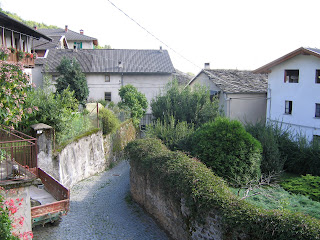
Street Scene in Brosso

One of the Two Piazzas in Brosso
 The other Piazza with City Hall on the left
Our first stop in Brosso was the home of my cousin on the Bovio side, Rita Loppo and her husband Italo. They live in a comfortable home on the northern edge of the village. The home is relatively new – about 40 years old – and with all the conveniences. Unlike most Brosso homes, it has a tiled roof instead of a slate roof.
Rita immediately retrieved an excellent bottle of vino rosso from her wine cellar, whereupon we sat in her living room and caught up as to our health, adventures, and major events of our lives. Probably 80 or more, Rita retains her quiet charm that I remembered from earlier visits. She remains tall and serenely elegant and healthy. Italo has to take oxygen because of damage to his lungs acquired from too many years in the mine. But he looks well and maintains his friendly and cheerful disposition.
Rita immediately retrieved an excellent bottle of vino rosso from her wine cellar, whereupon we sat in her living room and caught up as to our health, adventures, and major events of our lives. Probably 80 or more, Rita retains her quiet charm that I remembered from earlier visits. She remains tall and serenely elegant and healthy. Italo has to take oxygen because of damage to his lungs acquired from too many years in the mine. But he looks well and maintains his friendly and cheerful disposition.

L to R - Derek Raymaker, Rita, Darryl Raymaker, Italo
From Rita’s we went over to 86 year old Nene Valesa, who is a widow of another first cousin of my mother, Eraldo. Eraldo passed away some years ago. Her daughter Ornella had just arrived from her work at the post-office in Burgo – Franco, a little town on the Val D'Aosta road. Nene looks well. Her skin and facial features are very smooth and unwrinkled. She has trouble walking and is a diabetic. She was very happy to see us. She has live-in home care provided by Emmanuella, a young late teen or early twenty-something, comely Rumanian immigrant girl.

Back - Derek and Darryl Raymaker
Front - Nene and Ornella
There are a lot of Eastern Europeans throughout Italy, and many in Piedmont. Many of these immigrants are Rumanian, who of course speak a Latin-based language and have little difficulty learning Italian.
Nene's daughter Ornella who is in her early fifties, is happily married and lives in Brosso, the village that she was born and raised. A compact olive skinned and attractive woman, She and her mother Nene have always made my family welcome on our visits. They are truly warm and generous people
We walked about the town a little and inspected my mother’s maternal Uncle Giovanni’s home, as well as the home of Betty and Fiora, which they sold many years ago. Uncle Giovanni – who we in Canada always referred to as Uncle John - was a mechanic who worked for Fiat. He also worked for many years in Fez in Morocco. I met him late in his life in my first two visits in the sixties.
Uncle John's Brosso home - which was the Bolettino family home - became the subject of probably the only piece of civil litigation ever to put parts of the family at odds with one another. When he was near death, another cousin forged a new will leaving all of his property to himself. Uncle John had always expressed his desire to leave the family home to his two nieces in Canada – my mother and my aunt. I uncovered the fraud and retained excellent counsel in Torino, who righted the wrong commited and had the ne'er-do-well jailed for fraud. The home, which was in a seriously dilapidated state at the time, was sold to city dwellers who did a massive restoration and renovation, turning it into an attractive summer home.

The renovated Bolettino Family Home
We then walked towards Ornella’s house on the mostly cobble-stoned streets. After only a short distance, we met Renato Battistino. Renato, likely in his late seventies, has lived all of his life in Brosso. I had known two of his aunts and an uncle who lived in Bellevue in the Crowsnest Pass.
I reminded him that I knew his uncle Secoundo, and his Aunts Tonietta, and Rena in Canada as well as his aunt in Brosso, Quinta. We also spoke of his Canadian cousins Tecla and Ersilio Favero, both now-deceased longtime family friends. And we spoke of Kyle Nissen. Kyle is the Canadian free-style skiing star who finished 5th in the competition in the Torino Winter Olympics of 2006. Kyle is the grandson of Ersilio and lives in Calgary. Renato mentioned meeting Kyle during the Olympics when Kyle and his family journeyed to Brosso to meet the relatives and partake in the usual superb Piedmontese dining adventure. Meeting Renato was a very happy and emotional moment for both of us.

Darryl, Renato Battistino (cousin of Kyle Nissen of Calgary, a member of the Canadian Men's Freestyle Skiing Team who competed at the Torino Winter Olympics, 2006), Derek
It struck me that the people of the region, now that most had given up smoking and the men folk no longer working in the mines, looked very well despite their advancing years. It is not hard to see why. An excellent diet (Piedmontese food is generally quite light by Italian standards), a lot of walking exercise (there being differences in elevation even within the villages), a life removed from the rat race, good pensions and personal security, as well as a joie de vivre constantly on display probably leads to a longer life and a very good one in qualitative terms.
As my village wanderings continued I found that I was able to communicate in mostly French very easily with Ornella and the other people I met and certainly did not have any need for an interpreter.
When we got to Ornella’s, her husband Giacomo Grosso arrived from his work. He works for the Torino regional transportation system, in another nearby town in the province. He is from Inverso, one of the villages in the Val Chiusella. He is also the regional news correspondent for ‘La Sentinella,’ a newspaper in Ivrea. He plays the tuba in the band. He is a handsome gentleman of 58, very friendly and well-spoken. He intends to retire in a couple of years. They have two children – Federika and Gian-Paolo. Federika is in her early twenties and works in a restaurant in Barcelona. Ornella showed me pictures of her, and – like her mother – is a knockout. Gian-Paolo is 16, rides a motorcycle and is completing his high school in Ivrea. He is a very friendly and charming young man.

Giacomo Grossi, His Wife Ornella, Darryl
Ornella’s house is next door to where Romeo Fiorio, a cousin on my mother’s maternal side, lived. It was at the Fiorio house in 1963 that I learned something about the Piedmontese family eating traditions, one of which included drinking wine from a community bowl used by all members of the family. The other strange tradition – at least from the standpoint of a Canadian who grew up in a Province administered by Social Credit – was the willingness to allow small children drink wine with their meal.
Ornella and Giacomo’s home is a delightful combination of the old and the new. Old stone or plaster walls refinished, together with modern additions, but still preserving the existing character of the place. Right below Ornella’s house is the home of Esther and Guido (Esther was another cousin). I could not help admiring her slate roofed, ancient one story, well preserved home with a big walled front yard.
It was Ornella’s turn to make something up for dinner - a wonderful veal carpaccio, some pasta and salad and lots of good red Piedmontese wine of excellent vintage. Piedmont is known for its fine wines, some of which are Barbera, Barolo, and Barbaresco, and a multitude of others.
After supping like the Court of the King of Savoy, Derek and I were safely transported back down the mountain to our hotel in Ivrea.
Later in the evening, we went to find out what was going on in town. We found a dessert café on the banks of the River Dora and partook of some ice cream, and then happened upon a lively wine bar just up the street where a bass-vocal duo were playing some decent jazz. We had a couple more glasses of vino and called it a day.
Tomorrow would be another day up the mountain – and probably our last day in Brosso. Until the next time, of course.
DAY 3 – FRIDAY AUGUST 24
The arrangements we made late in the day before were that Ornella would pick us up at the hotel after work (at 3 PM) and then take us to see our cousin Renza – Romeo Fiorio’s daughter and my cousin on my mother’s side. Then we would go out to dinner.
After breakfast, given that we had some free time, Derek and I decided to take a drive towards Aosta. I had forgotten how close the distances were. We were on the A5 Autostrada heading north in short order. The A5 follows along the river Dora Baltea. The headwaters of the Dora Baltea are in the Alps. It flows south from the Alps the entire length of the Val d’Aosta to just south of Ivrea. The six-lane A5 Autostrada (or freeway, as we know them), follows the river and extends from Ivrea , up the Val d’Aosta to the mountain resort of St. Vincent, and thence west to the French and Swiss borders near Mont Blanc, the highest peak in the Alps and western Europe at 4810 meters or 15,702 feet. Also nearby are the mountains Monte Rosa and Cervino. Monte Cervino is the Italian side of the Matterhorn, the mountain’s name in Switzerland.
After a few minutes, we took an exit at the Val d’Aosta town of Verres, heading north on a mountain highway proceeding into ski and hiking country. After several esses and switchbacks we came upon the charming alpine town of Brusson, where we stopped for a cappuccino and surveyed the great view of the mountains. It was truly a fine sunny day. In addition to the gorgeous mountain vistas and picturesque chalets, the Val D’Aosta contains a couple of dozen stately and well preserved castles dating back to feudal times as well as ancient churches and other historic buildings. So even if you are not a skier, mountain climber or hiker, there is still plenty to see and do.

Brusson

Mountain Scene from Brusson
Leaving Brusson we then drove to the summit of the Col de Joue, where we stopped at a restaurant ‘Stella Alpina’ and had gnocci Piedmontese style that were excellent. We dined on the terrace looking down towards the City of Aosta. Needless to say, the hills were dotted with picturesque Swiss-like chalets. It all looked very rich and comfy indeed. We concluded lunch and took the hairpin turns to St. Vincent, and then it was back on the autostrada to meet Ornella at the appointed time of 3 PM at the Hotel.

Looking towards France - The View from the 'Stella D'Alpina' at the Summit of the Col de Joue.
When we arrived Ornella told us that the plans had firmed up for the evening. We would visit Renza and then go up to Ornella’s house and pick up Giacomo and then we were all going out to dinner at a restaurant just outside of Ivrea on the road to Aosta.
We once again drove back up the twists, turns and blind corners to the village of Brosso. Our first stop was at the Church, to take the obligatory view of the cemetery, the last resting place of so many of our family.

The Cemetery at the Brosso Churchyard
We drank in the wonderful vista of the Dora river and Ivrea below from the lofty churchyard. That done, we went over to Renza’s large home on the edge of town. At one time she and her now deceased husband ran an albergho there called the ‘Belavista.’ Renza is a robust and healthy woman in her late sixties who raised two fine daughters, both married with children, one of which was on vacation in Tunisia. I brought her up to date on the Canadian cousins and she did the same for the Italian side. She has some tenants in her big house. She worked at the post office for a number of years, as did her mother, but she was now in comfortable and no doubt, happy retirement.

Renza, Derek, Ornella
I should mention that most everyone in town looks well dressed and well nourished. The women – including women in their middle years - are really quite chic looking and ‘with it,’ well dressed and very well groomed.
From Renza’s we went to Ornella’s to pick up Giacomo for dinner and thence departed for the restaurant.
We arrived at the restaurant – just up the valley not far from Ivrea. It was near here that Renza’s daughter Mariangela’s husband had his contracting business. Betty arrived from Ivrea to join us, as well as Mariangela and her busband Andrea, Ornella and Giacomo and Derek and I.
Both Mariangela and Andrea looked great. They were the only ones of all of our Italian relatives who ever visited Canada. They came to Calgary in 1979 while on their honeymoon. Andrea had a successful business in the area, building and restoring buildings. He was able to retire at a relatively young age. Mariangela continues her job with the post office at the Town of Verres.
I was able to rap easily with them en francaise. Also there were in attendance Andrea’s brother Georgio and his wife, a lovely woman who had penetrating and compassionate eyes. Georgio complemented me in that he understood everything I said, and he didn’t think he was proficient in French. So we sat down to an excellent meal of salad, ravioli and very good enormous steaks. Conversations of relatives, previous visits, politics, Berlusconi (most of them thought he was a clown and perhaps a crook), life in Italy and Canada, dominated the evening.

L to R - Derek, Betty, Darryl, Mariangela, Giacomo and Ornella

L to R - Derek, Betty Darryl, Mariangela, Giacomo, Ornella and Giorgio

L to R - Derek, Mariangela and Andrea's son, Andrea, Darryl and Mariangela
Betty drove us back to the hotel.
The next day at about 10:30, Betty called. We both spoke to Betty and Fiora. They wished us God-speed, and we thanked them profusely.
Thus ended the adventure. It was a wonderful visit. The country as we all know is magnificent in many ways – whether it be art, its dramatic countryside, wonderfully preserved history, outstanding cuisine and wonderful vintages, generosity and the plain joy of living. Yes, Italy, most certainly Piedmont and the wonderful village of Brosso, has it all.
It makes one wonder why my forbearers ever left. But things were very much different there in those days than they are today.
Derek and I went on to Verona and Venice – 2 days each. He then returned, and I had two excellent days in Milan and then in London.
It was a great trip!
Wednesday, September 19, 2007
THE QUEBEC BY-ELECTIONS: WHAT DO THEY MEAN?
Let's look at them one at a time.
1. Saint-Hyacinthe-Bagot.
In the last General Election January 23, 2006, the results were (in round numbers):
Bloc - 28,000 (56%)
Conservatives - 12,000 (24%)
Liberal - 5000 (10%)
NDP - 2700 (5.4%)
Total votes cast - 50,000 (67% - based on 76000 eligible voters in 2007 by-election).
In the by-election September 17, 2007, the results were (in round numbers):
Bloc - 13,500 (42%)
Conservatives - 12,000 (37.5%)
Liberal - 2400 (7.4%)
NDP - 2500 (7.9%)
Total votes cast - 32,500 (43% based on 76000 eligible voters)
Summary:
1. Bloc lose 14%
2. Conservatives gain 13.5%
3. Liberals lose 2.6%
4. NDP gains 2.5%
5. Turnout down by 24%
Conclusion:
Conservatives make big gain on the Bloc. NDP gains a little on the
Grits. Turnout very low.
2. Roberval - Lac-Saint-Jean
In the General Election, January 23, 2006, the results were (in round numbers):
Bloc - 18,000 - 45%
Conservatives - 15,000 - 38%
Liberal - 3000 - 8.5%
NDP - 2000 - 5%
Total Votes cast - 40,000 (63% of 63,000 eligible voters in the 2007 by-election).
In the byelection the numbers were:
Bloc - 8000 - 26.8%
Conservatives - 17,500 - (59.7%)
Liberal - 2,800 - 9.6%
NDP - 700 - 2.3%
Total Votes Cast 29,527 (46% based on 63,000 eligible voters).
Summary:
1. Bloc loses 18%.
2. Conservatives gain 20 %.
3. Liberals gain a little - 1.1%.
4. NDP lose 2.7%.
3. Turnout down by 17%.
Conclusion: Conservatives win big over the Bloc. The rest is a wash. Turnout very low.
3. Outremont
In the last General Election, the results were (in round numbers):
Bloc: 12,000 (29%)
Conservative: 5000 (12%)
Liberals: 14,000 (34%)
NDP: 7000 (17%)
Total votes cast 41000 (65% of by-election eligible voters)
In the by-election, the numbers were:
Bloc: 2600 (10.9%)
Conservative: 2100 (8.6%)
Liberals: 7000 (29%)
NDP: 11,400 (47.5%)
Total votes cast: 24000 (37.5%)
Summary:
1. Bloc lose 18.1%
2. Conservatives lose 3.4%
3. Liberals lose 5%
4. NDP gain 30.5%
5. Turnout down by 27.5%
Conclusion:
NDP win big over the Bloc, and picks up a few points from the Conservatives and Liberals. Conservatives go nowhere in the big city riding. Turnout very low.
So who took it on the chin?
I say the Bloc. Its losses were the greatest in terms of popular support - 14%, 18%, and 18.1%. It also lost a seat. It bodes ill for the Bloc and by extension, Pauline Marois' PQ.
Who was the big winner? Why the NDP of course. They haven't had a seat in Quebec since Phil Edmonston fluked one in 1990 in a by-election in the Riding of Chambly. Edmonston, a contrary sort who continues to be a superb consumer advocate fingering 'lemon' autos, was also a Quebec nationalist. He was never at home in the NDP and packed it up without running again in the next General Election in 1993. That, so far as I know, is the only time the NDers ever took one in Je me souviens land. So, why did they win in Outremont? Apart from the qualities of the candidates, which I am not in a position to comment on, one could easily conclude that Layton's robust attack on the government's Afghanistan policy must have had an impact - and therefore a bright Amber light for Steve Harper.
For the Grits, it must have been a disappointment to lose Outremont. And for the Conservatives, the win in Roberval and the gain in Saint-Hyacinthe must have felt good. But their dismal performance in Outremont will give them pause.
The two leading parties - Grits and Conservatives - have more work to do in Quebec before they roll the dice and plummet the country into another General Election.
Monday, September 10, 2007
EXXON REX TO STELMACH: 'BE VERY CAREFUL'
Exxon is a big, big oil company. The biggest. Its roots go back to the kerosene days of the 19th century and the baby steps of the Rockefeller fortune. It is rich too. In 2006, it made in profit almost 4 and a half million bucks an hour. Its profit for the same year was a cool 40 billion. The government of the Province of Alberta - supposedly rich - made about 12 billion from oil and gas revenues this past year. This is about 30% of Exxon's profits. Exxon also owns 70% of Canada's largest oil company, Imperial Oil.
The new CEO of Exxon is a fellow with the rakish but fitting name of 'Rex.' Rex Tillerson. 'Rex' means a King, a Sovereign, a male king. He's a Texan. Rex is big in the oil biz and will become bigger in the years ahead. His predecessor was a fellow with a more modest and plebian moniker. His name was Lee Raymond. But don't let the name fool you. When Lee walked out the Exxon door for the last time a year or so ago, his golden parachute was, when it all added up, a cool 400 million. What is 400 million anyway? Its half the cost of the big new hospital to be built down in the southern extremities of Calgary. Its about 70% of all of the money spent to date on the 42 kilometres of existing LRT track in Calgary. That's the kind of retirement money Lee took from Exxon. Approved by the Board of Directors, naturally. All going into one man's pocket.
But Rex needn't worry. There will be plenty more where Lee's rainy day fund came from. And he's off to a great start. On the job for only a year, Rexy already had a pay raise of 17% to almost 2 million a year, and his bonus has gone up more than two-fold to about 3 million a year. When he bites the dust, you can rest assured there will be no tag days to pay his funeral expenses.
Yes, Lee Raymond did well alright. Not that his career was unblemished. It was on Raymond's watch - in 1989 - that the Exxon Valdez oil spill happened in the environmentally sensitive Prince William Sound in Alaska. It was one of the worst environmental catastrophes of all times. 240,000 barrels of oil - and some say much more - was dumped into the sea, killing wildlife and polluting shores. A half million seabirds perished. So did 5000 sea otters, 300 seals, 250 bald eagles and 22 orcas. The spill continues to affect the environment and will continue to do so for generations. The captain of the vessel, a relapsed alcoholic, was drunk when it struck the reef that caused the spill. The owner of the vessel: Exxon. Cleanup cost was about 2 billion dollars, and Exxon remains in litigation over the debacle to this day.
It is interesting to follow the litigation. I think it says something about Exxon. In a class action brought in 1994 by thousands of fishermen and landowners, native groups and so forth, an Anchorage jury awarded the actual damages for clean-up plus 5 billion dollars as punitive damages. Punitive damages are awarded when the offence giving rise to the lawsuit together with the aftermath is egregious. In this case, the short-term and long-term environmental impact caused by the spill was so extreme, that the jury deemed that a punitive penalty should be paid. The purpose is to teach the perpetrator and all other potential perpetrators of such a disaster that such irresponsible actions will not be tolerated. The 5 billion was one year's profit for Exxon at the time. It is now 13% of its current profit.
Exxon was not happy with the result. It carried on with the fight over punitive damages. The various stages of litigation had the award reduced to 4 billion, increased to 4.5 billion plus interest, reduced to 2.5 billion, and upheld at 2.5 billion. Not happy with the results so far, Exxon has decided to appeal to the Bush-heavy Supreme Court. The company has still not paid a dime towards the punitive damage award. For the record, its position is that since the mishap was caused by an accident, then the punitive damage award should be limited by law to 25 million. Besides, its lawyers say, the company has already spent 2 billion in clean-up costs and 1 billion in settling suits.
Well, the other day Rex was in Calgary to speak at the annual Spruce Meadows Round Table, a genteel gathering of 70 or so business notables who pass the day discussing and pontificating weighty issues while watching equestrian show jumping. It was a timely visit. The Alberta government-appointed panel on what to do with oil and gas royalties in Alberta is about to report its conclusions. And Rex was there to have his say, perhaps - with luck - even to have the last word. In a message tailored for the ears of the Stelmach government and the people it governs, Rex warned, "I say be very careful and recognize that none of us know what oil prices are going to be - none of us." He also urged caution in amending the 1 % sweetheart royalty deal in the oil sands, saying, ". . . you need to be very careful about dealing with ongoing projects . . . because all of that risk is still out in front of us." Of course Exxon is big in the oil sands - 'big' as in high double digit billions.
And, naturally, he resorted to that tried and true bludgeon that big oil and little oil in these parts always dig up for doing battle with governments that want them to cough up a little more for the people - the National Energy Program. He urged the policy makers to 'look at the past,' and remarked, "We have a history in Canada of failed energy policies and fortunately sensible people came in and fixed that."
As could be expected, many industry executives oohed and aahed over Rex's warning with pursed lips and furrowed brows, vigorously nodding their collective heads in approval.
Despite putting all that money into Exxon's coffers, its executives', and the retirement accounts of senior officers, Exxon still pursues government handouts like a smitten young man pursues his first young sweetheart. Back in June at the Exxon Annual Meeting Rex said that the Canadian taxpayer must kick in with part of the 16 billion necessary to build the Mackenzie Valley pipeline project. Otherwise, said Rex, it should be scrapped. Exxon, Shell and Conoco Phillips are partners in the project.
Whether he is working hard enough to earn his current generous salary and bonus take, or to receive retirement stipends of $400,000,000 (yes, count the zeros!) plus is highly problematic. But give Rexy his due. He's a company man through and through.
And that is something that Stelmach, his government and the royalty panel should remember. Rex is a company man. That company is Exxon. It is not the people of Alberta.
Let's hope Eddie gets it right.
Thursday, September 06, 2007
MULRONEY MEMOIRS: A BASKET CASE TRIES TO SETTLE OLD SCORES
I had been suffering from writer's block for several days. Feeling guilty. About disappointing my legions of readers. Hemingway used to call it 'black ass.' I was suffering from 'black ass.'
What to write about? Stelmach? Harper? Borrrrrrrrring! Afghanistan? Not boring, but God, if people don't get it about Afghanistan by now, they probably never will. What to write about?
Muldoon to the rescue! I might have continued staring at my computer screen in a state of suspended animation indefinitely were it not for Muldoon (as Canada's 18th Prime Minister is referred to by that splendid rag 'Frank Magazine').
We found out this morning that - oh, hell, let's call him by his real name -Mulroney mustered up the courage to really let the seven year deceased Trudeau have it. According to Mulroney, Trudeau wasn't morally fit to lead because he failed to support the war against Hitler and that he [Trudeau] opposed the draft during the war.
Mulroney was obviously smarting from Trudeau having called those who supported Meech Lake and the Charlottetown Accord names. For those who must be reminded or who have forgotten about what Meech Lake and the Charlottetown Accord were, these were basically constitutional bribes of power advanced by Mulroney and his Federal government to the Quebec separatist government to sign the constitution. Trudeau had called Mulroney and his ilk 'weaklings,' 'cowards,' 'snivellers,' and 'eunuchs.' Trudeau had said this in the inimitable understated way he said such things when he became pissed at weaklings, cowards, snivellers and eunuchs, who for their own aggrandizement, personal and otherwise, tried to turn Quebec into a province quite unlike the others.
As always, whenever Muldoon speaks, two things happen. First, you remember what a basket case he was and is, and secondly, you learn something new.
As to the basket case Mulroney, his outburst reminded us of his penchant for self-destructive over statement and exaggeration, his unrelenting passion for a glowing place in history that he believes is owed to him, and his holding his bete noir Trudeau responsible for the death of his pet constitutional proposals which, in his mind, would have stopped the separatists in their tracks and led him to time immemorial fame and glory.
The facts are these.
Mulroney's big mouth - his penchant for self-destructive over statement and exaggeration - consistently got him into trouble while he was in office (recall him telling the reporter that a good politician had to know when to 'roll the dice,' to win, and he had won Meech Lake by 'rolling the dice' at the right time - saying this, when he hadn't yet won Meech Lake, which he went on to lose).
Mulroney's unrelenting passion for a glowing place in history led to his constant preening and mugging before the cameras, and more blarney than the Canadian people could ultimately stomach, all of which was instrumental in the destruction of the Progressive Conservative Party.
And finally, there is no doubt that Trudeau fought effectively against Meech Lake and the Charlottetown Accords. But to credit Trudeau alone for their defeat - when they were rejected by every region of the country, is to give the great man far too much political credit. In fact, the Canadian people had figured out for themselves that Meech and Charlottetown were power bribes to Quebec that would make that province different and more powerful than the others. And so Canadians rejected them. By the way, Stephen Harper seems to have learned something from the Mulroney experience with Quebec. He is not bribing Quebec with power. He's doing it in the old-fashioned way - with money - as witness his last Budget.
So much for the basket case. Now what have we learned? We learned or at least were reminded that Mulroney still believes - and probably others of the now-defunct Progressive Conservatives - that Trudeau brought down Meech and Charlottetown.
If this is so, then by implication Trudeau's attack also led to the Tories defeat at the polls in 1993, because clearly, the nation's revulsion at Meech and Charlottetown was a major reason for the Tory debacle. And it was this debacle - the grotesque Tory defeat in 1993 that left them with two seats - that destroyed the Tory Party. And so it follows, if it was Trudeau who defeated Meech and Charlottetown, then it was he who destroyed the Tory party. Thus, according to this school of thought, Pierre Trudeau's effectiveness as a national leader did not end in 1984 when he left office. No, it carried on through 1993 and therefore, not only were Stanfield and Clark his victims. So were Mulroney and Kim Campbell.
Like Samson, Trudeau slew them all. If I may carry the biblical analogy a bit further, it can be fairly said that he slew Mulroney and Campbell with the jaw bone of an ass!
Wow! What a career! Of biblical proportions! 25 years of beating up and finally destroying the Tories! Longer than Mackenzie King!
One final comment. Mulroney says that Trudeau wasn't morally fit to lead, because as a young man in his very early twenties he did not support the war against Hitler nor the draft. Well, what about the moral fitness of a leader who accepts $300,000 is cash delivered to him in 3 instalments in quiet hotel rooms by an unsavoury businessman who for years has been fawning over him in order to get contracts for his clients?
Saturday, August 11, 2007
THE STRANGE CASE OF MAHER ARAR: THE COVER-UP COMES DOWN
So, finally, Canadians now know what really happened in the Maher Arar case. Getting there wasn't easy. We had to sue our own government to find out. But we did. The Judge found in the people's favour. The system worked.
Now, there is not one, but two components to the Arar case. The first is the matter of his detainment, transportation to Syria, his torture and his release. The second is the cover-up by Canadian polticians and the Harper government.
Remember Watergate? There were two components to Watergate. The first was the break-in at the Democratic Party offices. The second was the cover-up. It was the cover-up that brought Nixon down. The Arar coverup may yet help bring the Harper government down. At the very least, it besmirches his government and confirms his blind and misguided loyalty to the Bushies.
The Arar case has now been in the forefront of the news in this country for four years. It is as instructive as it is horrifying. Maher Arar's nightmarish, Kafkaesque experience as a result of being wrongly accused by government agencies running amok in secrecy, should never have happened to a Canadian citizen and must not happen again.
The whole sordid and shameful affair should be indelibly etched on the mind of every Canadian who places human rights at the forefront of our values. What follows is a brief review of the case and developments to date.
Maher Arar was born in Syria in 1970 and came to Canada in 1988 with his parents. In 1991 he became a Canadian citizen. He attended University and acquired a BSc from McGill in Computer Engineering and a MSc in Telecommunications from the University of Quebec. He married his Tunisia-born wife, who has a PhD in Finance. By 2002 they had two children.
Between 1997 and 2002 he and his family lived variously in Ottawa, Montreal and Boston depending on the locale of his employment. In 2001, he started his own consulting company within which he carried on his business as a telecommunications engineer.
He was placed under surveillance by the RCMP by reason of being seen in the company of a Syrian born young man from Ottawa, Abdullah Almalki. Apparently Almalki had done some high-tech business in Afghanistan which was considered suspicious.
On September 26 2002, while returning home from a visit to Tunisia, Arar was stopped JFK Airport in New York and detained by U.S. Immigration authorities. He was held in solitary confinement for two weeks. On October 7, he was told by a U.S. official that he was considered to be a terrorist and an al-qaeda member because he knew Almaki and another Canadian citizen of Arab origin from Ottawa, truckdriver Ahmed Abou El Maati.
On October 9, Arar was flown out of the U.S. by the U.S. authorities to Jordan and then a few days later to Syria. He thus became a subject of the U.S. policy of extraordinary rendition - the policy of transferring a detainee terrorist suspect out of the U.S. to another country which has no qualms about using torture to elicit confessions.
For several weeks, while incarcerated in a cramped, dark, rat-infested cell, the Syrian authorities beat the hell out of this Canadian citizen. They persisted until he confessed that he was trained as a terrorist in Afghanistan. Then they eased up on him. For six months he didn't see daylight.
During a visit by Canadian consular authorities in August, 2003, Arar said that he was tortured. He was released in October after being incarcerated for more than a year. He then returned to Ottawa where, together with his wife, he started a campaign to clear his name and to convince the public that he was not a terrorist or an al-qaeda member.
Shortly after his return, there were reports that he had been detained by U.S. authorities as a result of information supplied to them by the RCMP.
The RCMP, true to their tried and true Canadian cop traditions, decided to investigate itself over the Arar case. This was done by Superintendant Brian Garvie. His heavily censored report was released on September 25, 2004.
Among Garvie's findings were that the RCMP gave the U.S. authorities information on Arar with no strings attached, that an RCMP officer assigned to the Foreign Affairs Department may have known of the plan to ship Arar to Syria but said nothing, and that a Deputy Commissioner had put heat on Prime Minister Chretien not to tell the Syrians that there was no evidence that Arar was a terrorist, because he was still a person of 'great interest.'
On February 5, 2004 the Martin government, much to its credit, set up the "Canadian Commission of Inquiry into the Actions of Canadian Officials in Relation to Maher Arar," under Ontario Associate Chief Justice Dennis O'Connor, to find out what really happened. The Americans nixed this idea and didn't cooperate.
O'Connor is a highly respected Judge who has had a brilliant career as both a lawyer and a judge. Given his experience as the Commissioner of the Walkerton Inquiry, he knew how to handle political hot potatos. He was a perfect choice for the job.
It is highly relevant that Stephen Harper took over the reins of government on
February 6th, 2006.
The O'Connor Inquiry concluded its public hearings on September 14, 2005. O'Connor's report was issued on September 2006. As expected, it completely exonerated Arar. He also concluded that it was likely the U.S. put Arar through his ordeal because it relied on false information provided by Canadian officials.
The swift fallout from the O'Connor Report included an immediate public apology from the RCMP to Arar and his family. Shortly after, RCMP Commissioner Giuliano Zaccardelli resigned in disgrace because of inconsistencies in his testimony at the Inquiry hearings. The Government also apologized to the Arar family and agreed to pay them a settlement of 11.5 million dollars including legal costs.
It was at the time of the issuance of the O'Connor report that the Arar cover-up took place. Government lawyers insisted that before the report was issued, some 1500 words had to be kept from the public because their release would compromise national security.
The O'Connor Commission disagreed. It sued the government to have the censored 1500 words released. The result was the decision of the Federal Court last week to release about 1000 of those deleted words. And we now know a great deal more about the Arar case. For example, we have learned:
1. CSIS, in the words of its Deputy Director at the time Arar was sent to Syria, thought that Arar would be sent to the Middle East to be questioned in a 'firm manner,' so that the Americans 'can have their way with him.'
2. The RCMP, in applying to a Judge for a warrant to eavesdrop on telephone calls, didn't disclose that they were relying on information from a country with a poor human rights record [Syria] and did not make an assessment of the reliability of that information.
3. In respect to the same application for a telephone warrant, despite that the RCMP knew that a confession was obtained through torture in Syria, it nevertheless insisted to the Judge that the confession was accurate and true.
4. Although the Syrians, as early as one month after they had Arar in custody, told CSIS that Arar was a nuisance rather than a terrorist, Canadian officials refused to help in his release.
5. One of the 'national security' reasons for withholding some information was that the RCMP did not wish to compromise the goodwill of foreign agencies like the CIA with which the RCMP shared intelligence. In other words, the goodwill of the CIA towards the RCMP was paramount to the full disclosure of the facts involving the torture of an innocent Canadian in a foreign, rat-infested prison. As a result all references to the names of the foreign intelligence sources such as the CIA had been censored out along with the other 1500 words.
There is more fallout from the court's decision. The new Conservative RCMP Commissioner William Elliott, who replaced the disgraced Zaccardelli, admitted late last week that when he was Public Safety Minister Stockwell Day's Associate Deputy Minister he was among a secret group of bureaucrats who were involved in a process that led to the government deciding not to allow disclosure of the 1500 words of the O'Connor report. A shaky beginning, to say the least, for a new Commissioner who was selected to improve public accountability of the Mounties.
Day, the Liberals' gift that keeps on giving, tried to deflect responsibility on the bureaucrats. He said of the government attempt at censorship that "senior officials from various departments" decided to block out the passages before the government approved the recommendations. Day, by the way, is an old hand at using the courts at massive taxpayers' expense to avoid coming clean. One recalls the case of Goddard v. Day lawsuit of a few years ago in Alberta. Day had defamed a Red Deer lawyer in a letter Day had written to the editor of the Red Deer Advocate. At the time of the defamation, Day was a minister in the Klein government and so his legal fees were borne by the public purse. He put the lawyer through grinding and protracted litigation before settling the case on the eve of trial for $60,000. The total cost to the taxpayers who were footing the Day bill - close to $800,000.
Harper, for his part, made a public statement in the wake of the Court decision and the new disclosures that avoided any reference to the government cover-up. Instead, as is his wont, he emphasized that the Arar affair took place under the watch of the Liberals and not the Conservatives, and so the Grits were responsible for all of it.
Yet the cover-up took place on Harper's watch. And it is consistent with other examples of the Harper government's excessive secrecy or downright lies and misleading information designed to throw the public off sniffing out the facts. We have seen the Foreign Affairs Department lie and deny the existence of a report on the progress of the war in Afghanistan. When caught in the lie, it issued the report but it was heavily censored based on national security reasons. When the Globe and Mail produced the uncensored report, the national security arguement couldn't possibly stand up because the whole censorship exercise was shown to be merely an attempt to keep news - bad news in this case - from the public (See Darryl Raymaker Blog, Harper and O'Connor: Canada's Bush and Rumsfeld . . March 25, 2007).
Similarly, General Hillier has issued his order that neither will there be any information passing to the public about the fate or whereabouts of detainees captured by Canadian troops in Afghanistan. Without elaboration he argues that the security of the troops is imperiled if that information is publicly available. How this is so, he doesn't say. Security reasons, we suppose.
One final observation. Recently, the Harper government had occasion to appoint a new Chief Justice of Ontario replacing the departed Roy McMurtry. Its choice was to elevate to the Court of Appeal from the Ontario Superior Court, Warren Winkler. Winkler, by any standard, was a worthy appointment. However, so would have been Dennis O'Connor. O'Connor was already on the Ontario Court of Appeal and was the Associate Chief Justice. As such, he was the strong favorite to replace McMurtry. The Harper government chose Winkler over O'Connor.
That'll teach him, I guess.
Monday, August 06, 2007
HARPER'S AFGHANISTAN: A FINE MESS
I have predicted for some time that the perfect political storm likely to engulf the Harper government is Afghanistan.
Canada began its participation there for the right reasons. We agreed to help rid the world of the terrorists who organized 9/11 and the government that supported them - the Taliban. At the same time, we wanted to help the development of the country, to help children get an education, and assist in bringing about some semblance of the rule of law to the country. Good intentions. But as Samuel Johnson once wisely said 'The road to hell is paved with good intentions.' Afghanistan is turning out to be indeed a road to hell - for NATO troops there and the politicians of the countries who sent them.
The reasons for this international nightmare are plainly evident. Now that at least some of us have read some history of the region (the Prime Minister excluded, it seems [see, DARRYL RAYMAKER BLOG, July 5, 2007, 'Harper Gets Ready To Cut and Run - Again'] ), we realize that this war is an attempt to bring order to one of the wildest countries on earth. For more than 2000 years Afghanistan has proved itself to be a tough and well-nigh impossible nut to crack by powerful invaders and occupiers. From the era of Alexander the Great to modern times this mostly lawless country has always left their opponents either lifeless on the battlefield or beating a hasty, bloody, and disorderly retreat. Even vast and well-equiped armies from far more sophisticatred empires have failed to subdue the war-like propensities of the Afghan people. Alexander the Great didn't stay long. The British Army at the height of its Empire was routed there. And more recently, the Russians left in failure after racking up 15,000 dead Russian soldiers as part of the lost cause (See DARRYL RAYMAKER BLOGS, July 5, 2007 and March 18, 2007, 'Gordon O'Connor - In Over his Head').
The Kandahar region of southern Afghanistan is particularly difficult. For centuries it has been home turf to Pashtun tribes who roam the mountainous and lawless border region of Pakistan-Afghanistan. To the people who live there, life is cheap. Islamic religious fanatics abound. Added to this holy mess is the timid and weak NATO offering to the project - a scant 35,000 troops scattered throughout the country. Neither is there any great enthusiasm among NATO nations to relieve or help Canadians who, with so far 66 troops killed in action, are taking the worst of it.
But it gets worse. The NATO forces, together with the Karzai government are looking the other way while the poor Afghan farmers cultivate their only significant cash crop - poppies. This year there is a record harvest of poppies in Afghanistan. That harvest will be turned into the production of opium, which will thereupon provide nearly 90% of the world's supply of heroin - heroin that continues to poison the minds and lives of millions of people throughout the world. Most of the heroin users reside in western member nations of NATO - rich nations - whose citizens are rich enough to support a heroin habit. So Canada and other NATO nations involved in Afghanistan are not only pursuing a lost cause with little support. They are tacitly supporting the production of heroin which fries the brains and ruins the lives of millions of people - mostly westerners, and many Canadians.
And according to all credible reports, the whole situation there is getting worse by the day.
Once again Defence Minister Gordon O'Connor and the Chief of Defence Staff Rick Hillier are tripping over each other as to where Canada goes from here. Two weeks ago, O'Connor gave the sunny prediction - contrary to everybody else who knows something about what is happening in Afghanistan - that over the next four or five months Canada would take on a reserve role. He said that when Quebec's Royal 22nd Regiment - the Vandoos - had completed their rotation in Afghanistan, there would be 3000 Afghan Army personnel operating in Kandahar and that "we will continue to withdraw" as more Afghan army personnel are trained. He said that it would mean a reduction in Canadian combat duties.
A few days later, Hillier contradicted O'Connor, saying that the training process had just started and it would be a long time before the Afghans could do the job themselves. O'Connor tried to recover this past weekend at the Conservative caucus meeting in Charlottetown, by saying he and Hillier were on the same page and that he did not know how long it would be before the Afghans were capable of taking the pressure off of the Canadian troops.
This latest O'Connor/Hillier difference of opinion, when added to their misleading and contradictory statements on other embarassing issues surrounding the Afghan adventure, seems to have been the last straw for Harper. There is now strong speculation that O'Connor is on his way out in a very merciful and immediate shuffle to Veterans Affairs. Deputy PM Jim Prentice is widely predicted to replace the hapless O'Connor.
Chalk one up for Hillier. However the General, who has never met a microphone he doesn't love, may be next on the list for the secrecy obsessed Harper.
And if Harper doesn't wake up to the futility of it all soon, he too will be a victim.
Saturday, August 04, 2007
THE STELMACH DISASTER OF THE WEEK: RALPH KLEIN AND THE 'BANFF IN KOREA' FIASCO
Surely Special Ed deserved a rest. What with his battles with Mayor Bronco over money, homelessness, greedy landlords, the tree-huggers giving him grief over greenhouse gas emissions, the infection ravaged St. Joe's Hospital in his own riding victimized by the Tory government's utter failure in heath care restructuring, the rapid evaporation of Tory support in Calgary, and the loss of the Klein riding of Calgary Elbow to the Liberals, surely it was time to lay back and rest for awhile and enjoy the summer. Hopefully, to be reenergized and rejuvenated to join the battle for his political survival in the fall. By God, he deserved it.
Ah, sorry Premier, no such luck. The return of ex-Premier Ralph to the political limelight were to disrupt his plans. Klein had caused Stelmach some grief once before. It was when Klein announced within days after pocketing his legislature retirement allowance of 600 grand that he was taking a lobbyist job with a major blue-chip law firm. This no doubt caused Klein's protege, the current Premier, some embarassment. The haste in Klein's announcing his new post seemed to be in the minds of many, somewhat unseemly and mercenary (See DARRYL RAYMAKER BLOG, 'MORE PUNGENT ODORS FROM TORYDOM,' January 19, 2007).
And now Klein had done it again. On Wednesday it was reported that the ex-Premier was giving two speeches - one in Calgary on August 7th, and one in Edmonton on August 9th - in an effort to find Alberta investors who were prepared to kick in with 150 grand each to get a piece of a 30 million dollar resort development in Cheongsong county in South Korea.
The resort, to contain the usual garish combination of golf courses, hotels, condos and the rest of it, was to be developed by Spring Fresh Investment and Development Inc. It was ballyhooed in the promo literature as 'the Banff of Korea.' And Ralph was to be the developer's shill - the keynote speaker at the meetings.
The Company's VP Carson Cole said that Klein was being paid for the speeches and if he stuck with the company, he would receive some options. The smooth talking Cole said, "Well, quite frankly, we need a front guy . . . we needed a front guy that could attract people to show, you know . . This is high risk. Ralph Klein's perfect. Everyone knows he's a gambler." Indeed, we do. One recalls Klein, during his last term in office, leaving a First Minister's Conference in Ottawa on Health Care while it was still in session, in order to get in on the slot action at the casino in Hull before returning to back to the old grind in Edmonton.
It must have been particularly jarring for the current Premier to have heard this 'Banff in Korea' news. After all, his government wants the 'cooling off' period for lobbyists who have worked for the government to be 1 year after leaving government service. Although Klein is within the present rules, he has only been away from the Premier's office for 7 months.
However, there was more for the Premier to be concerned about with this 'Banff in Korea' stuff than merely the Ralph Klein shill. In addition to Klein being the keynote speaker, Tories Doug Griffiths, MLA for Battle River-Wainwright, and Thomas Lukaszuk, MLA for Edmonton-Castle Downs were listed as 'guest speakers.' And so, from the advertisements, it was easy for a reader to conclude that the MLA's along with Klein were helping to promote the project. The developer went even further in implicating the two MLA's by sending out an Email that said that they would be providing a 'blessing' for the project.
The MLA's, upon discovering the slimey inferences that were being drawn about their involvement as promoters of the project, were quick to deny that was the case and advised the developers of such. They said that they thought they were attending the meetings to talk about international trade and Alberta's role in the world economy, and in no sense were they promoters of the project. By Thursday, both Griffiths and Lukaszuk withdrew from the event stating that they did not want to appear as promoting the project.
Also on Thursday, Klein himself withdrew from the meetings citing 'legal reasons' for his withdrawal. There was no elaboration on the 'legal reasons.'
There the matter rests. But does the Premier? Not yet.
Subscribe to:
Posts (Atom)

